
Summary note: This post summarizes Anthropic’s official announcement “Introducing Claude Ship” (claude.com, November 23, 2026); it is not a reprint. @ClaudeDevs announced the same launch on X the same day. Original link: https://claude.com/resources/articles/introducing-claude-ship
Note: At check time (around 09:05 on November 24), x.com returned HTTP 403 across the site, so the @ClaudeDevs post could not be opened. Details here follow Anthropic’s official announcement, and figures are the company’s own, not independently verified.
Agents have taken over writing code, but reviewing it still meant a person reading every line. Claude Ship, launched by Anthropic on November 23, closes that gap: it strings review, fixes, and approval into one agent pipeline after a pull request is opened, with the goal of shipping code as fast as teams write it.
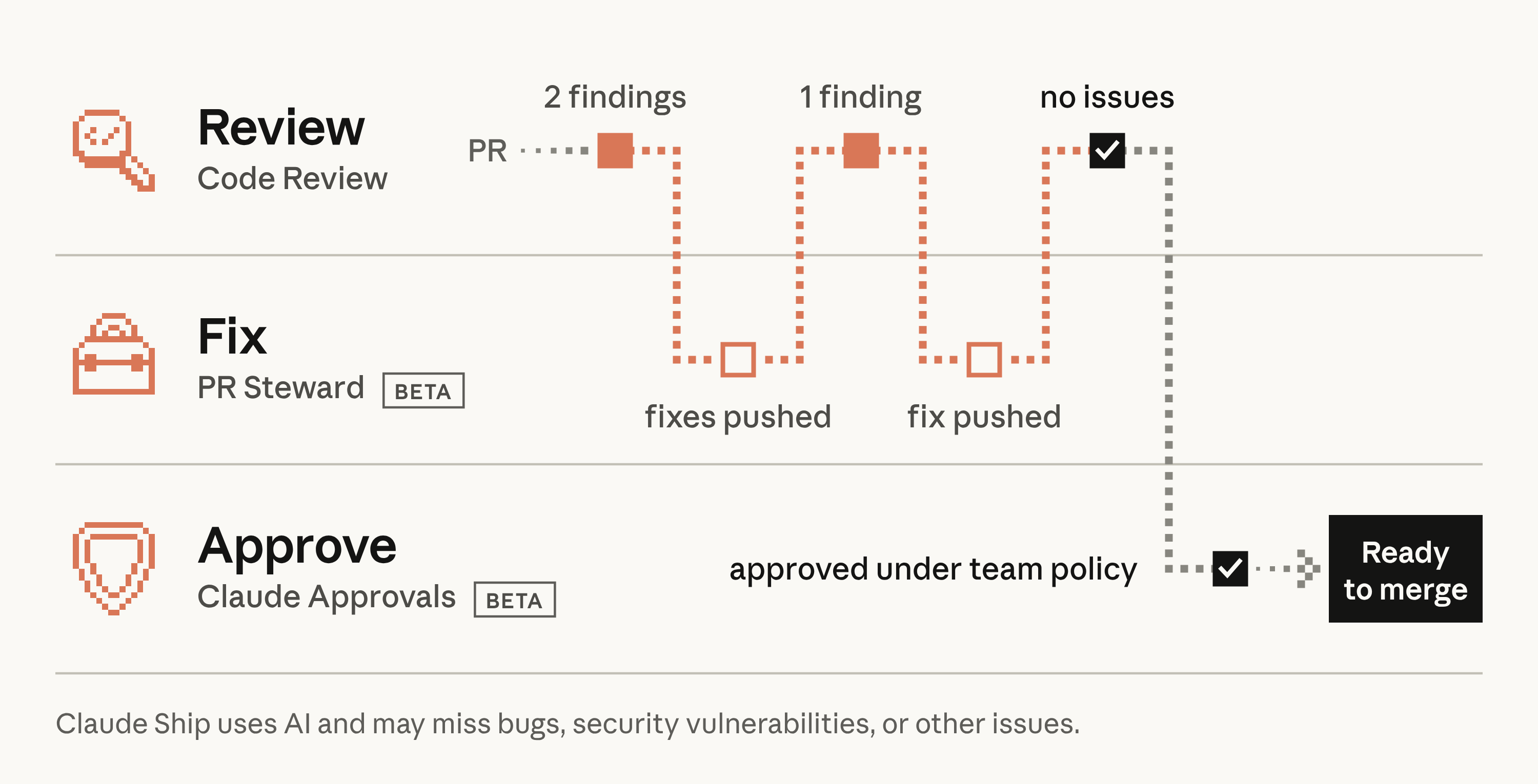 Image source: Anthropic’s official announcement
Three agents, one job each
Claude Ship is made of three agents with cleanly separated roles:
- Code Review (generally available): Reviews a pull request against the whole codebase through multiple lenses, collects findings, verifies them adversarially, categorizes them, and posts them ranked by severity on the affected lines. Each repository can pick Quick, Standard, or Deep review levels and choose when reviews run.
- PR Steward (beta): Keeps a PR green. It jumps in on failing CI checks, merge conflicts, and feedback from Code Review, other review tools, or teammates. After every push it comments on what changed and how to undo it. Developers can steer it with an
@claudecomment or tell it to step back with@claude stop. It is explicitly designed not to approve or merge pull requests — merge authority still rests with repository settings and GitHub branch rules. - Claude Approvals (beta): Decides on approval using a policy file the team writes in the repository. The policy can set how many people must approve changes to a path and where Claude may post an approving review. Routine changes can receive Claude’s approval when permitted, while designated scenarios require deeper human sign-off. Decisions can weigh Code Review findings or the team’s own classifiers written in natural language. Anthropic describes it as a smarter CODEOWNERS file.
Two ways in: /ship for developers, per-repository for teams
For developers: Run the new /ship command in Claude Code on your own change. Claude pushes it, opens the PR, reviews the change, and works through feedback and failing checks until it is ready to merge. What can merge still depends on the developer’s permissions and the repository’s branch rules. The command rolled out in Claude Code and the desktop app alongside the launch and counts as regular Claude Code usage.
For admins and engineering leaders: Enable it repository by repository. Once on, Code Review and PR Steward run automatically across a team’s pull requests; Claude Approvals starts when a connected repository has a policy file on its default branch, and an admin can turn it off. Each repository gets its own review level, run timing, and monthly spend limit. Anthropic recommends starting with one repository and running the approval policy in observe-only mode first — it only reports what the policy would decide and normally does not block merging — and requiring Claude Approvals’ green light in branch protection only once trust is built.
The announcement also flags two risks: with GitHub auto-merge or a merge queue enabled, a change can merge without anyone acting if the policy does not require a person’s approval; and Claude Ship may miss bugs, security vulnerabilities, or other issues.
Anthropic ran it on itself for three months
Claude Ship is not a paper product — Anthropic already runs it on many of its own pull requests. The reported result: on the Claude Code team, where Claude’s review is one layer of a broader process, merged pull requests more than doubled from June to September 2026 while the share reverted fell by more than 40%.
The announcement gives a concrete example of who can act now: a product manager on the Claude Code team read customer feedback showing the Analytics API documentation implied an Admin key could pull Pro and Team usage. She talked through the tradeoffs with Claude Tag, which opened a PR; Code Review found nothing blocking, a docs reviewer signed off, Claude Approvals passed, and the fix merged the same evening — the product manager wrote no code herself.
Billing, eligibility, and limits
- Billing: Claude Ship is billed by tokens, separately from a plan’s included usage. Cost depends on the number and size of pull requests, review level and frequency, and how much PR Steward work is involved. Admins can set spend limits for Code Review and PR Steward. Claude Approvals has no base charge, but classifiers in a policy consume billed tokens, and a policy-requested Claude review triggers a billed Code Review even in observe mode.
- Availability: Claude Team and Enterprise plans, for repositories on GitHub. Code Review is generally available; PR Steward and Claude Approvals are in beta.
- Excluded: Organizations using Zero Data Retention, the HIPAA configuration, or customer-managed encryption keys cannot use it.
- Promotion: Eligible Claude Enterprise organizations can claim at least $10,000 in Claude Ship credits by January 15, 2027, for use within 30 days of claiming.
Why this step matters
Claude Ship moves Anthropic’s agents from writing code to deciding whether code is ready to merge. The interesting part is not how thoroughly it reviews, but how control is designed: policy files, required checks, branch rules, and observe mode all keep the team in charge. Anthropic’s own advice is pragmatic — run in observe mode first, and only let it actually approve once trust is earned. The real danger of an automated PR pipeline was never an agent changing one wrong line; it is nobody noticing that something that should not have merged quietly did.
Written by

